


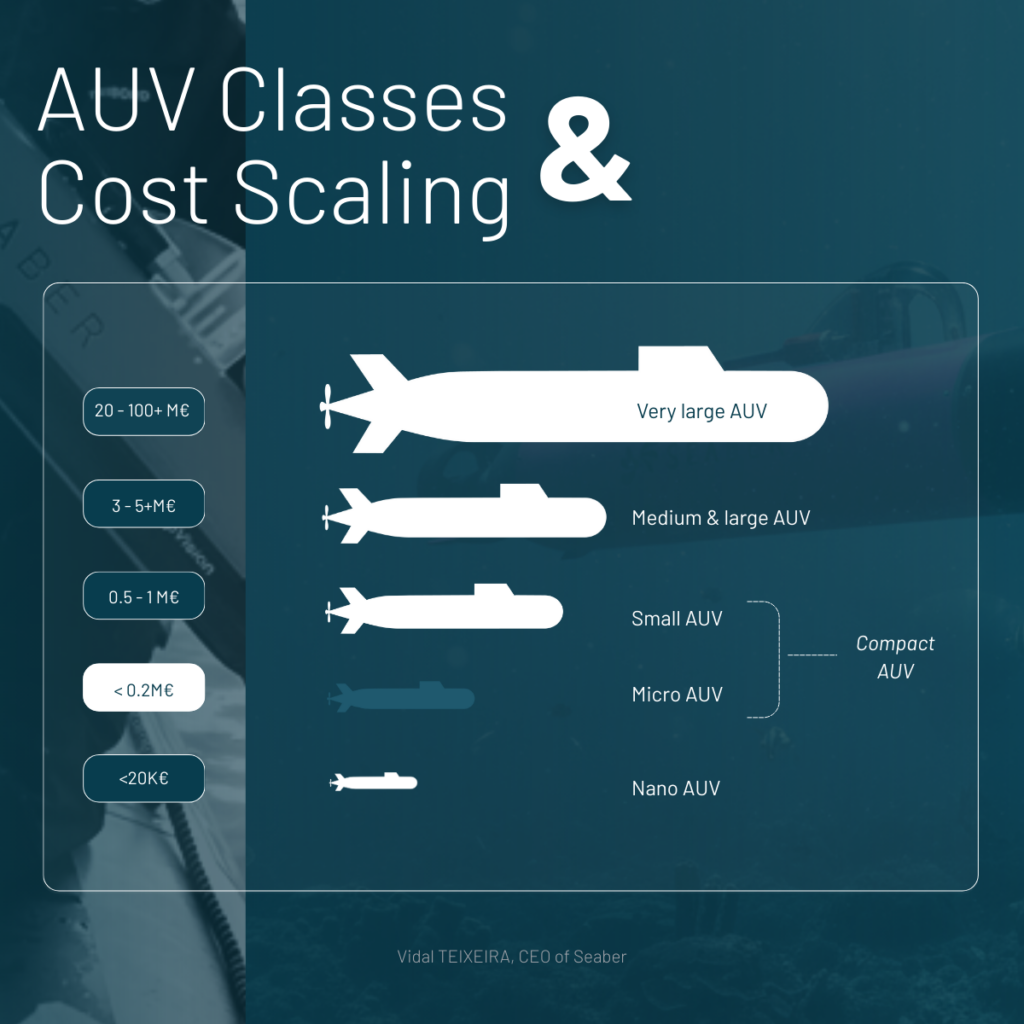
AUV Classes and Cost Scaling
AUV segmentation is changing and it matters
Observations from the underwater domain
AUV categories are still often treated as simple size labels. This is increasingly misleading.
Today, segmentation reflects fundamentally different system architectures and operational philosophies, and these philosophies are evolving rapidly.
This shift is driven by technology: sensor miniaturization, equivalent sensing performance at lower mass, and compact navigation sensors that were unthinkable a decade ago.
Micro and small AUVs are converging into a single class: compact AUVs. This is not a semantic change. It is an operational one. Compact AUVs now deliver:
– enough capability to be operationally relevant
– low enough mass to avoid heavy and costly LARS
– reduced dependence on dedicated vessels and deck infrastructure
For many missions, they represent the most coherent system choice.
Medium and large AUVs remain relevant, particularly for greater depths and for carrying specific payloads such as Synthetic Aperture Sonar. However, a recurring pattern appears across programs: operational complexity grows faster than capability as size increases.
Endurance and payload improve, but at the cost of:
– tighter sea-state limits
– heavier logistics
– higher crew and vessel dependency
This trade-off is often underestimated during system definition.
Very large AUVs are no longer just “large AUVs”. They are a transitional step toward autonomous submarines.
The fact that many countries are now developing their own very large AUVs is not incidental. Beyond long-endurance missions with still unclear operational contours, these programs appear to be a necessary technological pathway toward future unmanned submarine capabilities.
Their value is strategic and so are their constraints, costs, and deployment limits.
Nano AUVs are beginning to emerge.
Highly constrained in endurance and payload, but disruptive in other ways.
Their ultra–low cost and ease of deployment enable:
– rapid, local missions
– experimentation at scale
– new asymmetric underwater concepts
These platforms are likely to become vectors for asymmetric threats as much as tools for sensing and innovation.
This evolution is not about choosing a size.
It is about system architecture, operations, and realism at sea.
Which of these transitions do you think will reshape underwater operations the most?
👉 Link : https://www.linkedin.com/posts/vidal-teixeira-672a27b2_underwatersystems-auv-systemsengineering-activity-7406650689596170241-qj1b?utm_source=share&utm_medium=member_desktop&rcm=ACoAADgbq5IBdJEba6NSrWg-B7x4okZyTK9q-DQ