


Side-scan sonar & AUVs: frequency selection, navigation, and risk management
In the world of AUVs, the side-scan sonar is arguably the most widely used payload sensor for seabed detection and mapping — aside from the navigation sensors inherently required for vehicle control and safety.
👉 It plays a central role across many mission types: reconnaissance, object detection, UXO surveys, pipeline and cable inspection, seabed characterization, and more.
🎯 Frequency selection is therefore a structuring decision.
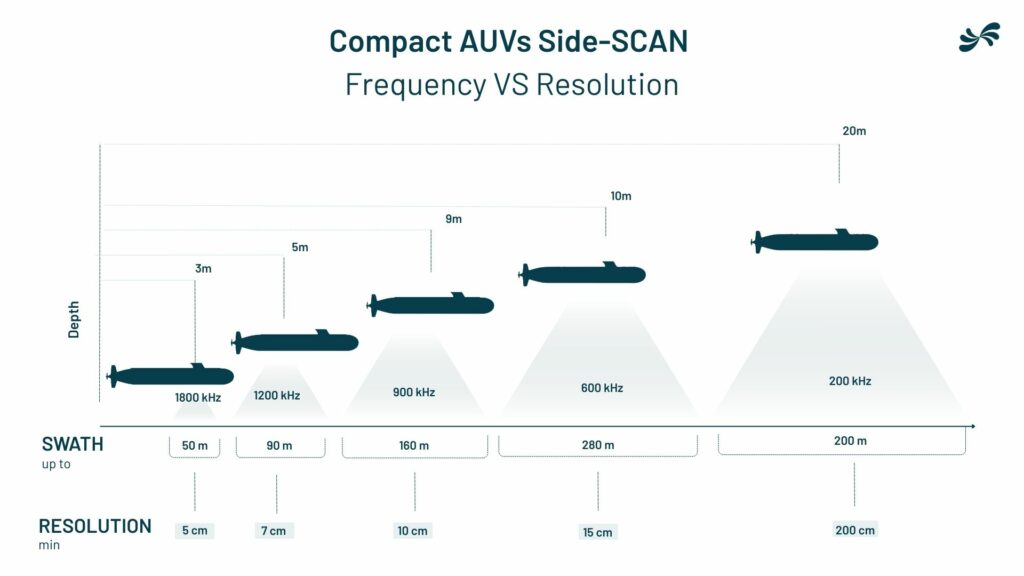
Side-scan sonars for AUVs span a broad frequency range, each involving well-defined trade-offs between:
📏 Resolution
🌊 Swath width
⬇️ Operating altitude and depth
⚠️ Operational risk exposure
📊 The objective of the accompanying graphic is to simplify and visualize these trade-offs, focusing on the most commonly used side-scan frequencies integrated into SEABER AUVs, in order to support both sensor selection and mission design.
⚠️ High resolution = low altitude = increased risk
Operating at higher frequencies generally requires flying closer to the seabed, reducing safety margins.
In complex or poorly documented environments, this significantly increases the risk of collision, entanglement, or vehicle loss.
Two operational strategies to manage this risk
👉 1. Prior reconnaissance
When the survey area is unknown, a robust and widely adopted approach is to:
– begin with a low-frequency reconnaissance mission (~200 kHz),
– fly at higher altitude with wide-area coverage,
– then conduct high-frequency detailed inspection once the environment is better understood.
👉2. Onboard obstacle avoidance
Integrating obstacle avoidance capabilities can enable higher-frequency operations from the first mission.
⚠️ However, this approach can introduce a false sense of safety:
– not all hazards are detectable,
– nets, lines, and other flexible objects remain particularly challenging,
– the risk of entanglement therefore persists.
In all cases: seabed-referenced navigation
Regardless of the strategy, an AUV equipped with a DVL remains seabed-referenced for navigation and altitude control.
➡️ Consequently, seabed perception quality, selected safety margins, and prior environmental knowledge remain critical mission drivers, independent of the level of automation.
Synthetic Aperture Sonar (SAS) is intentionally excluded from this discussion, as it introduces different constraints (navigation accuracy, processing, system complexity) that warrant a dedicated analysis.
💡 Key takeaway (expert view)
Choosing a side-scan frequency for an AUV is a global trade-off between acoustic performance, flight envelope, and operational risk management.
Advanced features such as obstacle avoidance do not replace a well-designed mission strategy or solid seabed understanding.
👉 How do you manage risk when operating AUVs in poorly documented or high-risk environments?
#AUV #SideScanSonar #UnderwaterMapping #Hydrography #Subsea #OceanTech #MarineTechnology #Sonar #DVL #UXO #Offshore #RiskManagement
(source: DeepVision and Marine Sonic specification sheets)